Start outside the boundary
Before identifying a subject, notice what the image excludes. A person may be looking toward someone we cannot see. A door may lead into a space withheld until a later shot. The boundary creates a difference between the world of the story and our access to it. That difference can support suspense, intimacy or simple curiosity, depending on the scene.
Describe the exclusion precisely. “We cannot see the person being addressed” is more useful than “the framing is mysterious.” The first statement can be checked. It also opens a question: does the next shot answer our uncertainty, or does the scene continue to deny us information? An emotional interpretation becomes stronger when it follows that pattern over time.
Placement is a relationship, not a rule
The rule of thirds can help a beginner organize an image, but it cannot explain a character’s feelings. A centered figure might appear powerful, trapped, exposed or comically formal. An off-center figure might appear isolated, yet the empty space may simply accommodate a second performer about to enter. Ask what the arrangement makes us anticipate.
Look at relationships between bodies, edges and objects. In a conversation, one person may have generous looking room while another faces a nearby frame boundary. That contrast could make their situations feel unequal. Test the reading against posture, dialogue and the wider sequence. If the arrangement stays identical when their relationship changes, it may be less expressive than you first assumed.
Negative space has a duration
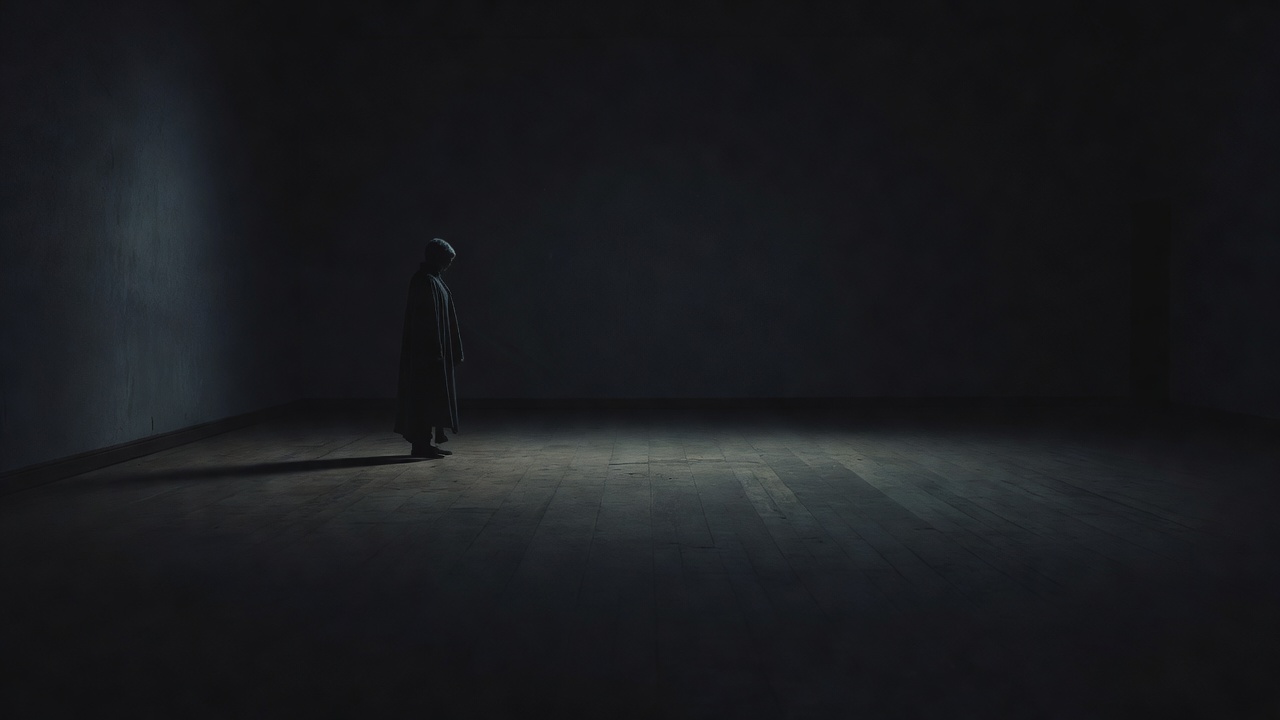
An empty area does not automatically represent loneliness. It becomes charged when we are given time to examine it or a reason to expect an arrival. A held shot of an empty hallway works differently before and after a character disappears through it. The pixels may be similar; our knowledge is not.
In Yasujirō Ozu’s Tokyo Story, rooms and domestic arrangements reward attention to ordinary spatial relationships. Avoid reducing the film’s visual approach to a single geometric trick. Consider who occupies a space, who has left it and how an adjoining shot changes its emotional weight. Composition participates in a larger rhythm of presence and absence.
Depth gives attention somewhere to travel
Foreground, middle ground and background can hold different kinds of information. A shoulder near the camera may partially obstruct a distant face. A window can keep another action visible while a conversation continues. Instead of labeling every obstruction a symbol of imprisonment, ask whether it limits knowledge, establishes proximity or directs the order in which we discover details.
Orson Welles and cinematographer Gregg Toland’s work on Citizen Kane is a useful starting point for studying deep-focus staging. Multiple planes can remain available to the viewer, but availability is not equality: movement, contrast and performance still guide attention. Deep focus does not mean that everything carries the same narrative importance.
Light and lenses change the evidence
A bright face against a dark wall may be easy to locate, while a figure in low contrast asks us to search. Before assigning moral meaning to light or darkness, identify its visible function. Does the light reveal an expression, hide an entrance or separate two people? A shadow can be practical scene geography as well as atmosphere.
Lens choice also interacts with camera distance. Perspective depends on the camera’s position relative to the scene; a longer focal length often encourages a more distant position for similar framing. Do not credit focal length alone for every apparent compression. For a useful test, keep the subject similarly sized, change lens and distance together, and compare how much background remains visible.
A three-frame exercise
Photograph one person beside a doorway in three ways: with generous surrounding space, with a tight crop and with a foreground object interrupting the view. Keep the action and lighting as consistent as possible. Write two sentences for each image: one describing visible evidence and one proposing an emotional effect. Then list an alternative explanation.
Ask another viewer what they noticed before sharing your interpretation. If they repeatedly look somewhere you did not expect, that is valuable information rather than a failed test. Composition is not a secret language that guarantees one response. It is a set of choices that makes some relationships easier to notice than others.
Next: Objects With Narrative Weight